Chris Bailey

Chris Bailey

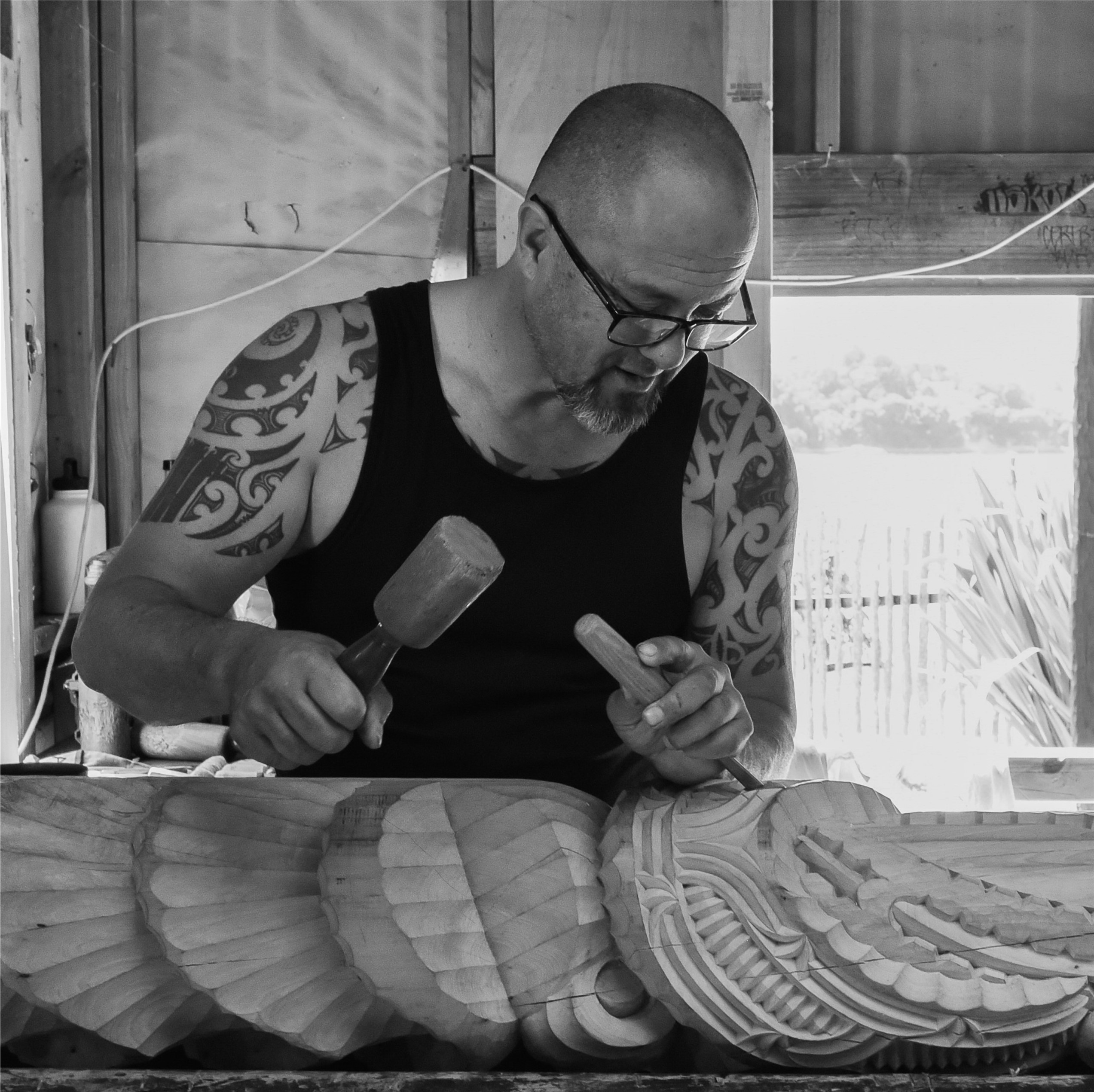
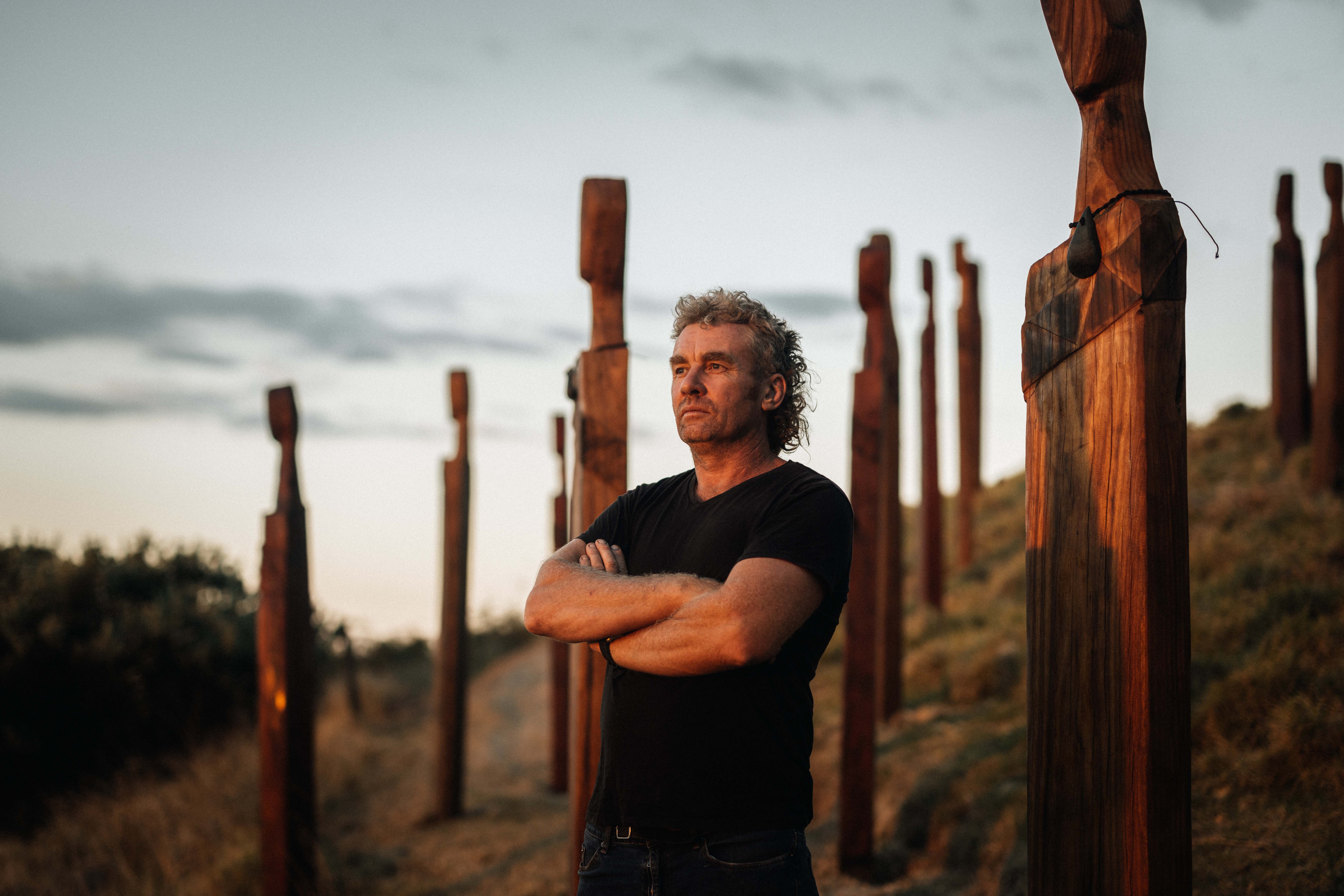
Chris Bailey (b.1965) lives on Waiheke Island and is of Ngāti Paoa, Ngāti Hako, Ngāti Porou, descent. In the early 2000’s he studied Māori material culture at Auckland University before becoming a full-time sculptor and carver.

Much of his work is monumental public artwork which is informed by his heritage as he works to engage the public with Māori concepts and return his peoples voice to the physical landscape. Working in bronze, stone and timber his works are held in both public and private collections throughout New Zealand and globally.

He was granted Te Ara Whakarei – lifetime Toi Iho status by Creative NZ in 2005, James Wallace Trust New Zealand Sculptor in 2014, and Creative Visionary Award / Ko te tohu whakanui mō te ringatoi by HMBA in 2025. He has exhibited in several Sculpture on the Gulf events

SJ Blake

SJ Blake

SJ Blake (b.1983) is an experimental artist and performance designer based on Waiheke Island. After studying at the Motley Theatre Design Course in London in 2007, she has worked across experimental performance while steadily moving toward a fine arts practice.

Blake explores mixed media, combining digital technologies with handmade processes to create new aesthetics, meanings, and emotional curiosities. Recent projects include Nikau Superette (Participating Artist)-New Lynn dairy, Tinned Goods – Anomalous Gallery / Studio One Toi Tū and Night Flight (a community site specific performance)-the culmination of a six-month Blake NZ artist residency.

Her immersive performance A Fantastical Journey by Boat, which incorporated VR, was selected to represent Aotearoa at the 2021 ARS Electronica Festival. Environmental decline and the ocean remain central themes in her work.

Elliot Collins

Elliot Collins

Elliot Collins is an artist, researcher, and tutor who works across a range of media within the visual arts. He gained a practice-led Ph.D. from AUT University in 2019, researching Memory Markers in the Landscape in Aotearoa New Zealand.

His interests focus on ideas of present/absent texts within ‘memory markers’ in Aotearoa New Zealand, alongside motifs that represent distinctive forms of meaning-making narratives. Collins’ practice references poetry and language, the naming of things, as well as memorials, memory, and time. He aims to expand ways of recording and documenting silences in relation to the environment and cultural narratives, contributing to expanded knowledges.

Born in Tāmaki Makaurau in 1983, he now lives and works in Waitara, North Taranaki with his wife, son, and dog, on the whenua of Te Ātiawa.

Sione Faletau

Sione Faletau

Dr. Sione Faletau (b. 1991) is an Aotearoa-born Tongan artist based in Ōtara, South Auckland. His multidisciplinary practice spans performance, sculpture, installation, and digital art.

He completed a BFA (Hons, First Class) in 2013, an MFA (Hons, First Class) in 2015, and a Doctor of Fine Arts in 2022 at Elam School of Fine Arts, University of Auckland. His doctoral research examined Tongan masculinity from an Indigenous perspective, drawing on Talanoa conducted with more than 140 people across the Tongan islands of ‘Eua, Ha‘apai, Niuatoputapu, Tongatapu, and Vava‘u.

Grounded in Moana knowledge systems—particularly ongo (sound, feeling, presence) and kupesi (patterns)—Faletau’s recent work explores sonic mark-making and projection mapping to create immersive spatial environments.

He was part of the inaugural Creative Australia & Creative New Zealand Digital Fellowship (2022) and has undertaken residencies with Te Pūnaha Matatini and Tautai. His work has been presented in major exhibitions including the Hawai‘i Triennial, Bundanon Art Museum, and the Govett-Brewster Art Gallery.

Anton Forde

Anton Forde

Forde (Taranaki, Gaeltacht, Gaelic, English) is widely celebrated both locally and internationally for his esteemed sculptural practice, which explores whakapapa, wairua, and our profound connection to the natural world. His work bridges tradition and contemporary form, honouring Māori worldviews while engaging universally with themes of identity, guardianship, and spirituality. Grounded in indigenous knowledge yet resonant across cultures, his sculptures invite reflection on our responsibilities to the whenua and to one another.

Forde studied under Professor Robert Jahnke within the Māori Visual Arts programme, Toioho ki Āpiti, at Massey University, where he completed a Postgraduate Diploma in Māori Visual Arts with Distinction, followed by a Master of Māori Visual Arts with First-Class Honours. His academic grounding continues to inform a practice deeply committed to cultural continuity and artistic innovation.

Gill Gatfield

Gill Gatfield

Gill Gatfield (b. 1963) lives in Whangaparāoa. She completed a Master of Fine Arts (Hons) in 2004 and Bachelor of Laws in 1988 from University of Auckland. Her abstract sculptures and installations address ancestral intelligence and speculative futures, in real and virtual worlds.

She was artist in residence at NARS Foundation New York 2025, Foreign Objekt 2024–25, Saas-Fee Art Institute NYC 2024, Poison Creek 2023–24, Ionion Center Greece 2023, Vermont Studio Centre USA 2019, and KØN Museum Denmark 2015. Her work is exhibited internationally, including at Sculpture by the Sea, Venice Art Biennale 2022 European Cultural Centre, Kunstverein Rosa-Luxemburg-Platz Berlin, UNESCO Geopark Ionion Islands, and Venice Architecture Biennale 2018.

Gill has public sculptures in Auckland and Sydney. She created the virtual monument HALO for Wellington Sculpture Trust 40th Anniversary, presented also at Waitangi and New York.

Sean Hill

Sean Hill

Sean Hill is a multidisciplinary artist of Kiwi/Samoan descent based in Ngamotu, Taranaki. He completed an Honours degree in Visual Arts at Auckland University in 2016. Sean’s practice focuses on conceptual exploration using movement, frequency, colour, texture, nature, and materials to express energy in a physical form, creating a visual language often through abstract representations.

Sean has exhibited overseas with Scott Lawrie Gallery (Scotland) and Alcaston Art Gallery (Naarm/Melbourne). His exhibitions include Synchrotopia in 2024 (solo) and 2026 (solo) at Govett-Brewster window space, and Energtopia in 2024 (solo). He received a CNZ emerging artist funding in 2024 and a Govett-Brewster artist residency in Tonga funded by CNZ in 2024. He exhibited at Govett-Brewster Art Gallery with Lalaga in 2022 and 2024, was a finalist for NZPPA Awards and Molly Morpeth Canaday Awards in 2025, and created a commissioned sculptural artwork for Te Tuhi Art Gallery, Flowergy, in 2025.

Stevei Houkāmau

Stevei Houkāmau

Stevei Houkāmau is a full-time uku artist based in Te Whanganui-a-Tara Wellington. Working with uku (clay) since 2011, her practice considers uku as both body and memory — a material that records touch, carries whakapapa, and anchors the relationships between tāngata, tīpuna, and whenua.

Her work has been exhibited widely across Aotearoa and internationally, and she has undertaken residencies in the United States alongside Indigenous art gatherings throughout the Pacific. Houkāmau has represented Aotearoa at FESTPAC in Guahan and exhibited at Munich Jewellery Week in 2024. In 2023 she received the Kiingi Tūheitia Portraiture Award and held a solo exhibition at Objectspace, Tāmaki Makaurau. She has been invited to the BACA Biennale in Québec, Canada, in 2026. 2027 marks her first inclusion in Sculpture on the Gulf.

Fiona Jack

Fiona Jack

Fiona Jack is an artist based in Tāmaki Makaurau Auckland. She teaches at the Elam School of Fine Arts, Waipapa Taumata Rau | University of Auckland. Fiona’s artistic practice ranges from large-scale public commissions to social projects formed through dialogue and research. She draws on recognizable visual and textual languages to examine the systems, social movements, and politics of representation within forms that hold collective memory.

Fiona has curated exhibitions including Portage Ceramic Awards 2025 at Te Uru Contemporary Gallery (2025) and Emory Douglas: Minister of Culture, Black Panther Party at Gus Fisher Gallery, Auckland (2009) (with Andrew Clifford). Her writing has been published in Counterfutures, Femisphere, and several artist books. She holds an MFA from CalArts and is currently a PhD candidate at the University of Westminster.

Virginia King

Virginia King

Virginia King was born in Kawakawa, Northland. She attended Wellington Polytechnic, then Elam School of Fine Arts, Auckland and, while living in London in the 1970s, Chelsea Art School, Hammersmith. Sculpture became her preferred art form in the early 1980s.

Over the past four decades, King has created a portfolio of large-scale, site-specific works for public locations and private collectors. By magnifying and abstracting the scale of natural life forms, she draws attention to the beauty and vulnerability of our environment. Her vessel forms have evolved from symbols of exploration, migration, and nurturing to become symbols of life and survival.

An Antarctic Artist Fellowship in 1999 was a pivotal experience. A visit to the spectacular Lake Vanda strengthened her commitment to the microsphere, marine protozoa, and foraminifera. Enduring themes in her practice include ecology and survival and the delicate balance between sustainability and progress. King continues to create works in her Auckland and Waiheke Island studios.